Sunday, August 23, 2020

One monk and his dog

Toby the Collie is a favourite with visitors to
Merton Priory today.
 

At Merton there is archaeological evidence of both dogs and cats in the Priory. The 1387 visitation by Bishop William Wykeham chastised the canons for keeping hunting dogs, and indeed for hunting with them. 

Regulars (nuns, monks, canons) weren't supposed to keep dogs (or cats or any other pets). At Whitby Abbey, no dogs were to be allowed in the claustral buildings, and if a dog got in, it was to be caught and told off (probably beaten). Various bishops' visitations castigate regulars for keeping pets. In the Merton case, canons shouldn't keep hunting dogs because they shouldn't be hunting. And if male canons shouldn't be hunting, then certainly female nuns shouldn't. In 1338, Bishop Northburgh told off Alice, prioress of Whiteladies in Shropshire, for keeping hunting dogs. I love the idea of nuns on a hunt.


A miller's dog from the Luttrell Psalter
Dogs and cats in the Middle Ages were chiefly kept to be useful - as vermin control and as hunting aids. The range of breeds we have now, much wider than in the Middle Ages, shows the change in purpose of dogs and cats, as they have become less necessary for living and more decorative.

Regulars' diet was supposed to be basically vegetarian, with only a little flesh. Food was a problem in keeping pets - if you have to feed your dog or cat on flesh, then you need to be having meat frequently, but you weren't supposed to. (It's interesting, and salutary, to think that our increase in pets nowadays means a vast increase in eating meat - but also that pet numbers increased only because we could eat meat more easily.)

Another reason that regulars shouldn't keep pets is that they were a distraction from divine contemplation, the chief purpose of nuns, monks and canons. Archbishop Greenfield of York wrote to the prioress and subprioress of Swine in 1314 

not to allow dogs to enter the choir during divine service lest the devotion of the women be lessened or divine obsequies impeded.

(Item injungimus priorisse et subpriorisse quod non permittant caniculos intrare chorum tempore divini obsequii si per eos devocionem dominarum subtrahi contigerit vel divinum obsequium impediri.) 

This shows that regulars had pets, and they loved them. Chaucer's portrait of Madam Eglantyne, the prioress in the band of Canterbury pilgrims, is of a soft-hearted animal-lover.

Small hounds had she, that she fed
With roasted flesh, or milk and fine white bread.
But she'd sore weep if one of them were dead,
Or if men smote it with a stick to smart:
And all was pity, and a tender heart.

You can read more about medieval pets here:


Thursday, August 13, 2020

Plants in the Infirmary Garden

All monasteries grew their own medicines.  Excavations at Soutra on the Scottish borders have shown a wide variety of herbs - including opium poppies (which probably weren't grown on the site, preferring a warmer climate than the cold, wet borders).  Soutra was an Augustinian foundation, and it treated all sorts of people and conditions.  Merton's infirmary was large, and might have looked after more than the canons, but in any case, it would have needed a well-stocked infirmary garden.  This was could have been in the infirmary cloister garth, with additional space elsewhere.

There's a detailed plan of the Abbey of St Gall from over 1000 years ago, and it shows both the physic garden and the vegetable garden.  The monks grew sage, watercress, rue, cumin, iris, lovage, pennyroyal, fennel, climbing beans,  pepperwort (cress), costmary, Greek hay (fenugreek),  rosemary, mint, lily and rose.  In the vegetable plot, they had onion, garlic, leek, shallots, celery, parsley, coriander, chervil, dill, lettuce, poppy, pepperwort, radish, parsnip, cabbage, chard and fennel - and more besides.

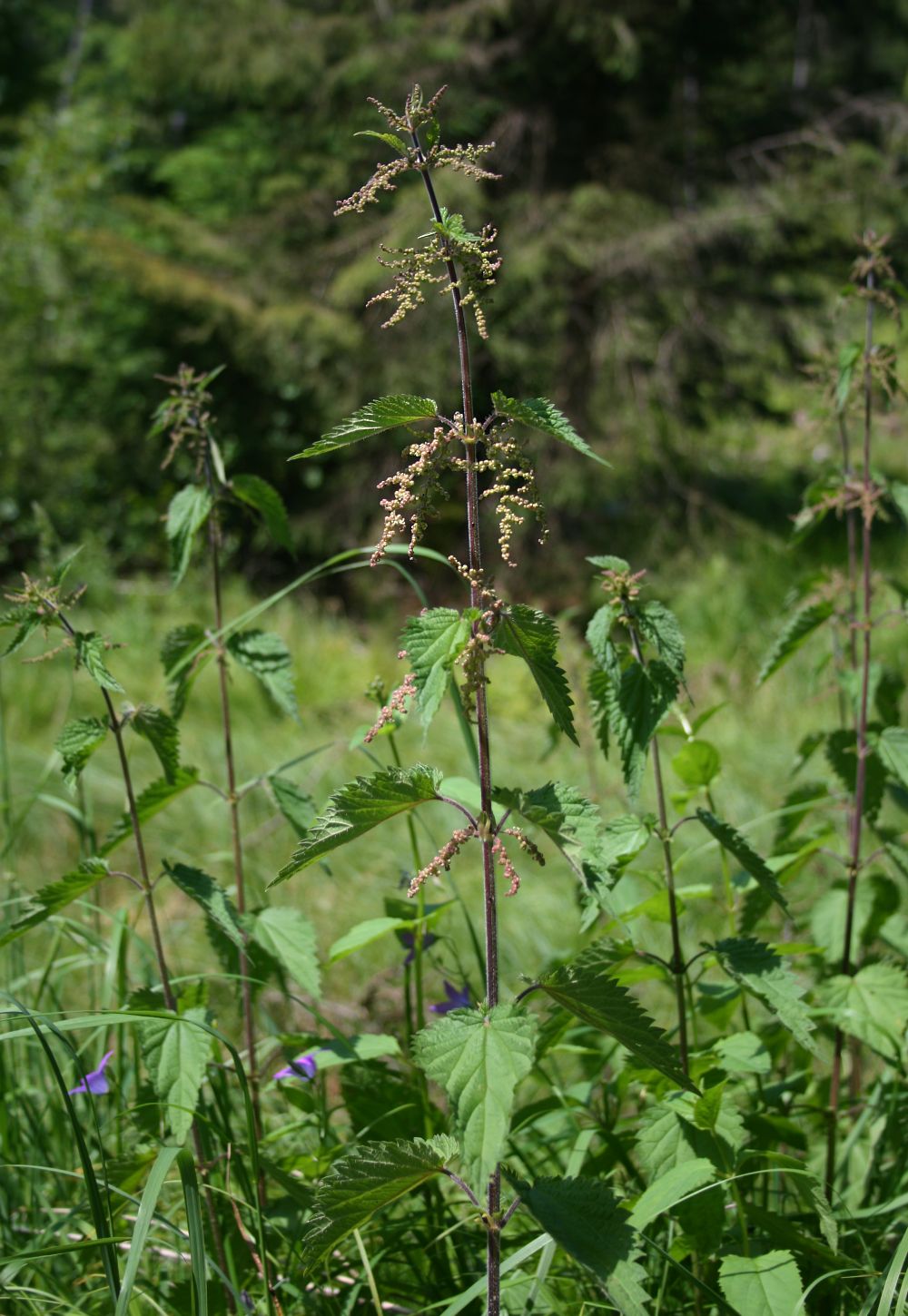
Excavations at Merton found all the grains one would expect - wheat, rye, barley, oat.  In addition, archaeologists found hazel and walnuts, grapes, plums, apples, raspberries, blackberries, legumes of various sorts, and junipers.  As for herbs, there were lots - from the ubiquitous stinging nettle (traditionally used for rheumatism) to the poisonous henbane (like opium, an anaesthetic/ pain-killer).  One monastic garden had a special enclosed bed for its poisonous herbs, which was kept locked!

Archaeologists also found lots of black mustard seeds.  Black mustard was used as an anti-inflammatory - a cure for back-ache, foot-ache, and lots more.  Mint also grew abundantly - in fact, it was grown so much in the area that one of the best varieties of mint is called Mitcham Black Mint (Mentha X piperita).

Lots of herbs/ wild flowers have medicinal names, like woundwort, also found at Merton.

Saturday, May 23, 2020

Good (and Bad) Habits - materials (plants)

There was no polyester or any other plastic material until the 20th century.  Cotton only came into British clothes in the 18th century, when Britain started to trade with (and invade) India in a big way.  Instead, clothes were made of more local materials – linen, hemp, wool, leather, fur.

Linen: 

This is made from flax (linum).  It’s strong and quick-drying – and cool in the summer.  For those reasons, linen is excellent for underwear.  Our canons wore linen breeches and shirts in the summer.

Flax grows all over Europe, and its seeds are used for linseed oil. ret, the stalks for a week or two so that the fibres start to break apart.  Then you dry it.  Then you can work it.  First you stutch the stalks – hit them with a wooden batten.  This breaks up the woody pith so that it can be removed.  Then you comb the fibres – this is called hackling.  Now the fibres are ready to be dressed and spun.

Ireland is the centre of linen production in the British Isles.  Here’s an Irish video on how to make linen.
After it’s been harvested, you have to soak, or
and here’s another, using a water-wheel to drive machinery
and here’s how it’s done nowadays.

In the days before machinery, flax took a lot of hours of a lot of people!

Did you know?
The word ‘line’ comes from linen – a linen thread was used to measure the straightness of line.

Hemp

Hemp (cannabis sativa) was processed in the same way.  It is coarser than linen, and it’s amazingly strong.  It was used particularly for making ropes – including the ones that hanged people!


Other plant fibres would have included nettle.  Nettle is processed in a similar way, too, and makes a very good fibre.  Considering the number of nettles we have, and the fact that we've got to stop using plastic, isn't it time we used nettle for our clothes and cordage?


(Nettle is also good to eat.  Here's a recipe for nettle pesto.)


Friday, May 22, 2020

Good (and Bad) Habits - towards a virtual exhibition

  You are what you wear


Clothes are our outer skin.  They are part of how others see us, and how we see ourselves.  They reflect our tastes and our aspirations.  Nowadays we have lots of clothes, because we have all sorts of artificial (plastic) materials and industrial processes which make clothes cheap and available to everyone.

In the Middle Ages, clothes were all of natural materials and made by hand:  they were expensive.  Some clothes were more expensive than others, and it was very easy to tell - just by what your clothes were made of, never mind how they were cut - how rich you were.

In the later Middle Ages, laws were passed forbidding people of lower classes to wear upper class clothes.  By then, the class system was in theory quite rigid - but obviously it wasn't in practice, because otherwise you wouldn't have needed these laws!

For church people clothes were supposed to be simple.  Christ and his disciples lived in poverty so that they could spend money instead on helping others.  Church people were supposed to follow their example.  Because you should focus on others, you should yourself be humble, so that you get rid of any self-importance and selfishness.  Also, church people were also supposed to be focusing on God and heavenly matters, and not on worldly matters like how they looked.  This was especially the case for people in monasteries.

Merton Priory was Augustinian.  St Augustine's Rule said that:
There should be nothing about your behaviour
to attract attention.
Clothes, therefore, should be as humble as the canons who wore them.  When you joined a monastery, you gave up all individual property.  Everything was to be held in common.  That included clothes.  Augustine's Rule again:
And just as you have your food from one pantry, so, too, you are to receive your clothing from a single wardrobe. If possible, do not be concerned about what you are to wear at the change of the seasons.
The Augustinian Rule was a bit vague, though.  It said that you had to get your clothing from the common store, but it didn't say what the clothing was.  For that, we have to go to the other great founder of monks, St Benedict.  He said monks should wear:
 a tunic, a cowl, a belt for work, and for the feet
shoes and stockings.

This monastic dress was called a habit.  Because there were different sorts of monastics, there were different sorts of habits - a bit like football strips or army uniforms.  The Augustinians' habits looked something like this.  (Right is John Studeley, c.1500, from St Frideswide's, Oxford. Left, a diagram of a habit.)


We know most about what they wore from a handbook of Barnwell Priory, just outside Cambridge.  There, canons received clothes twice a year.  At Easter, each canon got:
  • one a surplice or rochet of 7 ells of stuff (an ell was 45” /114 cm)
  • one sheet of 6 ells
  • three pair of linen breeches, each of which is to be of 5 ells
  • one pair of summer hose of soft leather, which ought to rise above the knees
  • one pair of shoes of leather
  • one pair of gaiters of serge or canvas
  • one cope (cloak) of frieze without fur
At Michaelmas (29th September) each canon got:
  • one new tunic of woollen, or one cassock of lambskin
  • a pair of boots of felt, and a pair of gaiters of woollen, and two pair of slippers similarly of woollen
  • a black lambskin to mend the fur of the hood of his cloak. 
The chamberlain was in charge of the clothes.  He gave them out and took them back in again, and made sure they were repaired and washed.  He gave old linen to the poor.

Friday, April 24, 2020

Henry Mitcham and the Stolen Chalice

Almost a Harry Potter title.  This is from Alfred Heales' Records of Merton Priory.

In January 1263, the king's law court heard that:
1) William Vadlet (appropriate name) had sought sanctuary in the church at Merton Priory having killed Richard Crudde.  He left the country ('abjured the realm coram Corona', says Heales), and forfeited all his goods.
2) Henry Mitcham stood in the infirmary chapel and 'fessed up that he'd nicked a Priory chalice.  He also fled the country (presumably wanting to keep both his hands).  He said that William Tooting had aided him.

Heales 139-140.